

Cross-Platform Industrial Edge
Industrial IoT Gateway for Linux
vNode is an industrial IoT gateway for Linux that connects PLCs, industrial devices and OT applications with IT, MQTT and cloud systems. It runs on Linux x86-64 and ARM64 platforms, including supported Debian, Ubuntu, Raspberry Pi OS, RHEL, CentOS, Oracle Linux and Amazon Linux environments, and provides web-based configuration, industrial protocol connectivity, unlimited tags and connections, and resilient data delivery.
Same Power. More Flexibility.
vNode can be installed and run on both Windows and Linux, giving you the freedom to deploy where it fits your infrastructure.
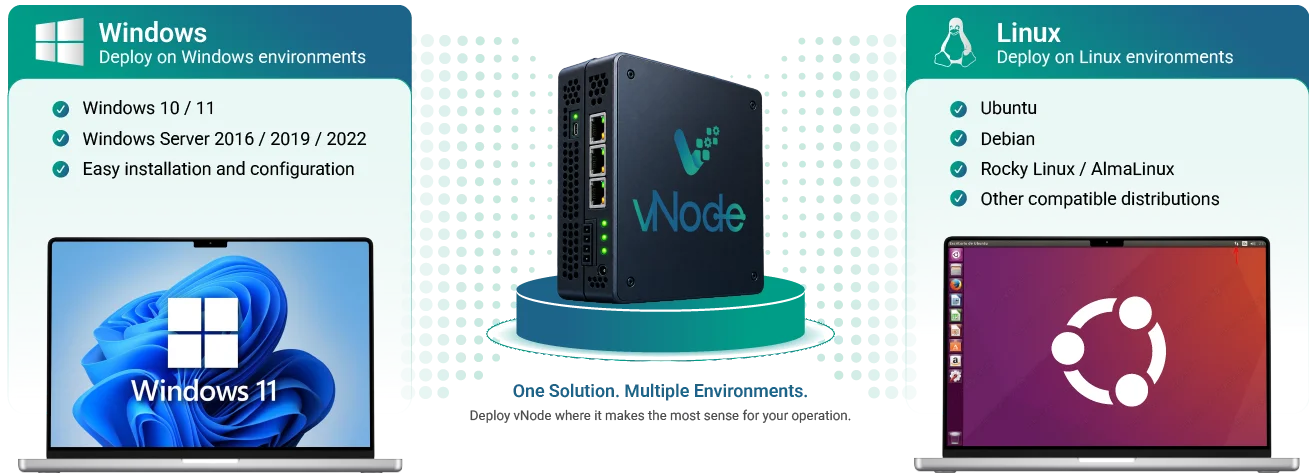

Same Features
Full functionality on both platforms

Flexible Deployment
On-premise, edge or virtualized

Reliable Performance
Built for industrial environments

Your Infrastructure
Your choice, your control

Why Linux
Why Use an Industrial IoT Gateway for Linux
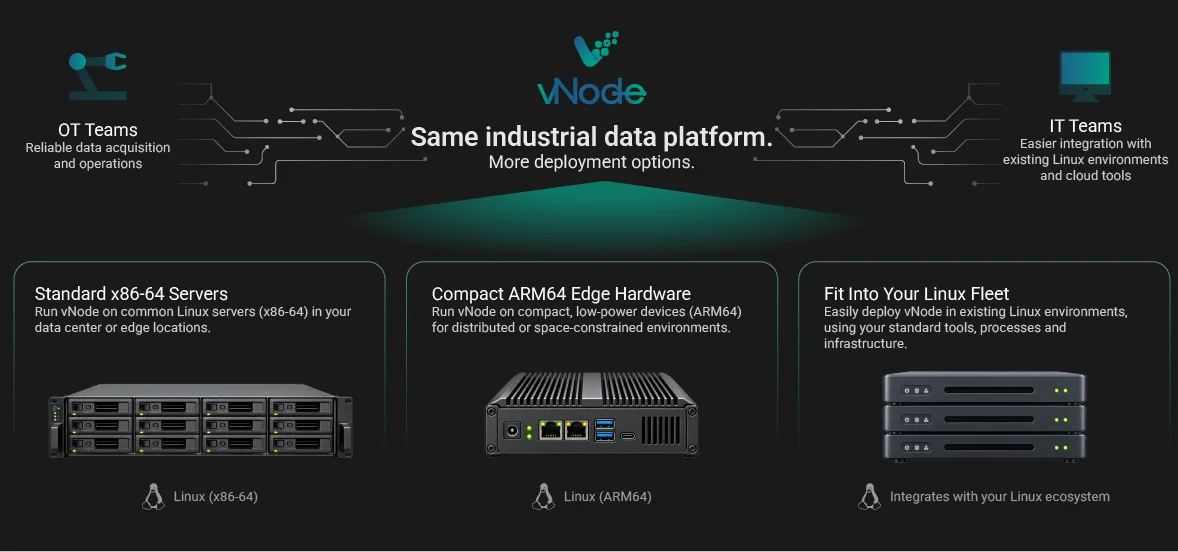
An industrial IoT gateway for Linux gives OT and IT teams flexibility that a Windows-only edge stack does not: the same industrial data software can run on standard x86-64 servers or on compact ARM64 edge hardware, fit into an existing Linux fleet, and align more directly with cloud and IT operations.
This does not make Linux universally superior. It is one deployment option among several, and the right choice depends on the project’s existing infrastructure and hardware.
Supported Linux Platforms
The current vNode 1.22 User Guide lists the following Linux families for this industrial IoT gateway for Linux. Always check the current User Guide for exact supported versions before deployment.

Debian / Ubuntu
Debian 10+ and Ubuntu 20.04+.


RHEL / CentOS
RHEL 7, 8, 9 and Red Hat-based CentOS 7, 8, 9.

Oracle / Amazon Linux
Oracle Linux 7/8 and Amazon Linux 2/2023.
Run Anywhere. More Flexibility.
Linux x86-64 and ARM64 Edge Deployment
The same industrial data software can run on standard x86-64 servers or on compact ARM64 edge hardware, fit into an existing Linux fleet, and align more directly with cloud and IT operations.

Flexibility
Choose the hardware that fits your needs
Cloud aligned
Works seamlessly with your cloud and IT operations

Same software
One vNode platform across Windows or Linux

Your choice
Use what fits your project and infrastructure
More Reasons
More Reasons to Choose This Industrial IoT Gateway for Linux

Reliable with Store & Forward
For supported data paths, vNode Store & Forward can retain pending industrial data locally on the Linux node when a destination is unavailable and forward it once communication is restored. This is useful for remote plants and distributed sites.

Web-Based Configuration
vNode on Linux is configured through the same embedded web interface as on Windows, reducing the need for a local engineering workstation at each edge node.

Unlimited Tags and Connections
vNode’s licensing model does not impose per-tag limits, which matters for edge consolidation on a single Linux node.

Multi-Site OT-to-IT Architectures
A Linux vNode node at each plant can acquire local OT data and forward it to a central node or directly to IT/cloud systems, optionally paired with vNode’s reverse connection architecture for closed OT networks.

Alternative to Windows-Only Connectivity Servers
Linux support is no longer a niche requirement: several vendors, including PTC with Kepware Edge, now offer Linux-capable options. vNode runs natively on Linux, Windows and ARM; compare drivers, architecture and licensing for your project.
Need the Installation Steps?
Verify our user manual on how to install vNode on Linux.


Frequently Asked Questions
Can vNode run on Linux?
Yes. vNode works as an industrial IoT gateway for Linux: the current vNode download center provides Linux x64 and ARM64 installers.
Which Linux distributions are supported by vNode?
The vNode 1.22 User Guide lists Debian 10+, Ubuntu 20.04+, Raspberry Pi OS 64-bit, RHEL 7/8/9, CentOS 7/8/9, Oracle Linux 7/8 and Amazon Linux 2/2023.
Does vNode support Linux ARM64?
Yes, vNode provides a native Linux ARM64 build in addition to x86-64.
Can vNode run on Raspberry Pi?
vNode provides an ARM64 Linux build and its current documentation explicitly lists Raspberry Pi OS 64-bit. Hardware suitability for a production industrial environment should be evaluated separately from software compatibility.
Can a Linux vNode gateway connect to Modbus and OPC UA devices?
Yes, the Linux build uses the same protocol module ecosystem as Windows, including Modbus and OPC UA.
Can vNode publish industrial data from Linux to MQTT?
Yes, the same MQTT Client module used on Windows is available on the Linux build.
Can vNode send Linux gateway data to AWS or Azure?
Yes, Linux deployments can publish to cloud services including AWS IoT and Azure IoT Hub through the same output modules.
Does the Linux version use the same web configuration interface?
Yes, vNode on Linux is configured through the same embedded Web UI as on Windows.
Does vNode support Store & Forward on Linux?
Yes, Store & Forward is available on Linux for the data paths where it is supported, buffering data locally during interruptions.
Is vNode a Linux alternative to Kepware?
vNode is a cross-platform industrial connectivity option with native Linux x64/ARM64 support. Compare the exact drivers, architecture and licensing of each product for your project rather than relying on an outdated Windows-only assumption.
Can vNode run in Docker or virtualized environments?
Check the current vNode datasheet and User Guide for the exact virtualization and container platforms supported for your version.
Do Linux deployments have tag or connection limits?
No, vNode’s licensing model does not impose per-tag limits on Linux deployments, the same as on Windows.